Yea, We have a new password. I am Susan, Karens #6 sibling. I copied Christines post so all will know how much we appreciate your prayers. If anyone can make it to the mass we would love to meet you.
Talk Later,
SUSAN
To all the kind souls out there in blogger, thank you soo much for all the loving and heartfelt prayers. Our family truly appreciate them. I too will miss Karen's posts. Rest assured, we are doing our best to reset the password to delete the posting that is not and never will be any part of what Karen's message was. Anyone in the Milwaukee or surrounding area, please know that we are having a memorial mass/service in Milwaukee at St John's Cathedral -downtown. The Mass will be Saturday, September 1 at 10 am. A major majority of the siblings will be there, and we would love to meet any and all of Karen's friends and external family. Even if you've never met her, but were touched by her blog, please know you are welcome and we can share her spirit with you. Again, thank you to everyone for the prayers and kind words. Please know that all are welcome and well needed.
With Love and Prayer,
Christine Knapp (Litteral) #8 of 8
15 August, 2007 08:05

Thursday, August 16, 2007
Friday, July 20, 2007
Normative Catholicism
Sherry Weddell at Intentional Disciples, before she began the Catherine of Siena Institute, belonged to the Nameless Lay Group. She's written about that over there, and also posted a list that the Nameless Lay Group made yon many years ago. It's still challenging and still true, so I've brought it over here for you-all to noodle with in the comment box.
from the Nameless Lay Group of Seattle:
.
from the Nameless Lay Group of Seattle:
1. It is NORMAL for lay Catholics to have a living, growing, love relationship with God.
2. It is NORMAL for lay Catholics to be excited Christian activists.
3. It is NORMAL for lay Catholics to be knowledgeable about their faith, the Scriptures, the doctrinal and moral teachings of the church, and the history of the Church.
4. It is NORMAL for lay Catholics to know what their charisms of service are and to be using them effectively in the fulfillment of their vocation or call in life.
5. It is NORMAL for lay Catholics to know that they have a vocation/mission in life (primarily in the secular world) given to them by God. It is NORMAL for lay Catholics to be actively engaged in discerning and living this vocation.
6. It is NORMAL for lay Catholics to have the fellowship of other committed lay Catholics available to them, to encourage, nurture, and discern as they attempt to follow Jesus.
7. It is NORMAL for the local parish to function consciously as a house of formation for lay Catholics which enables and empowers lay Catholics to do #1-6 above.
.
Tuesday, July 17, 2007
Answering the Cave Man's question
Vir Speluncae Catholicus asked me a question, in a thread about cozying up with the SSPX, which I promptly and politely answered, but he has deigned not to allow the answer to post, Unfortunately, I didn't keep a copy of my answer, but I am pretty sure I can recompose it.
The Cave Man asked:
Those Catholic people who have thrown away the Faith and run away from their bishops to go be a Lutheran or Anglican or X-brooker or whatever are indeed in the same pityable position as the SSPXers
The biggest difference between the SSPX, SSPV, CMRI, Spiritus Christi, the followers of the antipopes Michael and Pius XIII, et alii, and (other) Protestants is that the vast majority of the SSPX and company have been Catholic, and have thrown it all away to go their own way, out into the wilderness, in their own willfullness. Whereas the vast majority of Lutherans, Anglicans, etc., have never been in the Church to separate themselves. have never had a proper bishop to guard their faith, and are not running away from anything. In fact, many of them are diligent about seeking out and clinging to every crumb of Truth and Faith us Catholics have left laying about outside over the centuries. We need to evangelize them all.
That's where my attempted comment at the Cave Man's ended. But, I think another paragraph's in order:
This is actually a judgment on us. Many poor cradle-Protestants, with only the crumbs of the Truth and Faith that we've left laying around, have been very graced and become very spiritually sleek and strong, whereas too many of us cradle-Catholics, with full access to the complete banquet and the stuffed pantry of Truth and Faith from babyhood, could not care less, and are such wimpy starvelings. We need to pray for each other and evangelize ourselves, also.
.
The Cave Man asked:
Karen Marie said...
A "rad-trad", short for "radical traditionalist", is someone who falsely claims to keep the Holy Tradition as an excuse to separate themselves from the Holy Church and from their proper bishop.
Does that include Anglicans, Lutherans and Calvinists who also falsly claim to keep Holy Tradition (as they see it per Henry VIII, Martin Luther, John Calvin) as an excuse to seperate themselves from the Holy Church and from their proper bishop?
Well... does it?
Those Catholic people who have thrown away the Faith and run away from their bishops to go be a Lutheran or Anglican or X-brooker or whatever are indeed in the same pityable position as the SSPXers
The biggest difference between the SSPX, SSPV, CMRI, Spiritus Christi, the followers of the antipopes Michael and Pius XIII, et alii, and (other) Protestants is that the vast majority of the SSPX and company have been Catholic, and have thrown it all away to go their own way, out into the wilderness, in their own willfullness. Whereas the vast majority of Lutherans, Anglicans, etc., have never been in the Church to separate themselves. have never had a proper bishop to guard their faith, and are not running away from anything. In fact, many of them are diligent about seeking out and clinging to every crumb of Truth and Faith us Catholics have left laying about outside over the centuries. We need to evangelize them all.
That's where my attempted comment at the Cave Man's ended. But, I think another paragraph's in order:
This is actually a judgment on us. Many poor cradle-Protestants, with only the crumbs of the Truth and Faith that we've left laying around, have been very graced and become very spiritually sleek and strong, whereas too many of us cradle-Catholics, with full access to the complete banquet and the stuffed pantry of Truth and Faith from babyhood, could not care less, and are such wimpy starvelings. We need to pray for each other and evangelize ourselves, also.
.
Saturday, July 14, 2007
Two totally exceptional Saints
Today the Church commemorates two truly exceptional holy people: Saint Camillus de Lellis, and Blessed Kateri Tekakwitha.
I am not my own; I have given myself to Jesus. He must be my only love. The state of helpless poverty that may befall me if I do not marry does not frighten me. All I need is a little food and a few pieces of clothing. With the work of my hands I shall always earn what is necessary and what is left over I'll give to my relatives and to the poor. If I should become sick and unable to work, then I shall be like the Lord on the cross. He will have mercy on me and help me, I am sure.
------ Blessed Kateri Tekakwitha

Today the Church celebrates one of the scariest of the scary-holy penitent saints, Blessed Kateri Tekakwitha.
Tekakwitha was born in 1656, the daughter of a Mohawk chief, the head of the Turtle clan, and his wife, a captive Algonquian woman who was a Catholic Christian. When Tekakwitha was four, she lost her mother, her father, and her brother in a smallpox epidemic, and she was left badly scarred and nearly blind. Her name means "she pushes all before her," and most likely refers to her habit of feeling in front of herself so she wouldn't run into stuff, but that name was also appropriate because she seemed to have a gift from childhood for domestic management, for imposing order on chaos. This talent kept her tolerated by her surviving relatives, who otherwise considered her a burden and who were upset that she would not allow herself to be married off.
When the Jesuit missioners arrived in her village, she was one of the first converts, in 1676 when she was twenty, and was baptised with the name Kateri, Mohawk for Catherine. This was to the extreme displeasure of her relatives. When their treatment of her degraded from grudging neglect to outright abuse, she left, and moved to a settlement about 200 miles away that was entirely Christian, living a life of deep prayer and strict austerity, in reparation for the sins of her nation.
When on a visit to Montreal she met some religious sisters, she was drawn to their life, and set out to form a community of sisters in her village, but was discouraged from that by the pastor; however, she herself made the vow to the counsels in 1679, becoming the first consecrated person among the Mohawk, in fact among any of the original nations of North America.
Never strong or healthy, and weakened by her austerities, she died at the age of 24 on this day in 1680.
===========
Today is also the memorial day of Saint Camillus de Lellis, founder of the Servants of the Sick [who still thrive today, and have a motherhouse in Milwaukee].

Camillus was the son of a military officer, born in 1550. His mother died when he was still a toddler. Following his father's trade, Camillus became a mercenary soldier while still very young, fighting first for Venice and then for Naples.
Camillus also has an addiction to gambling, and lost so much that he had to take a second job working construction to repay his gambling debts. He was working on a building belonging to the Capuchin Franciscans when they brought him to conversion.
He left the military and entered the Capuchin novitiate three separate times, but injuries from his fighting days forced him to leave each time. He went to Rome seeking medical treatment, and there became a protege of Saint Philip Neri (that God-bitten character!). Camillus moved into San Giacomo hospital for incurables to live, and, eventually, became its administrator.
Aware of his total lack of education, he began elementary school at the age of 32, studying with the local children, and after long study was ordianed a priest. He formed the Congregation of the Servants of the Sick, now commonly called the Camillans, dedicated entirely to the care of the sick. Camillus honored the sick as living images of Christ.
As it says in today's Office of Readings passage, a citation from a biography written by one of his companions:
.....The mere sight of the sick was enough to soften and melt his heart and make him utterly forget all the pleasures, enticements, and interests of this world. When he was taking care of his patients, he seemed to spend and exhaust himself completely, so great was his devotion and compassion. He would have loved to take upon himself all their illness, their every affliction, could he but ease their pain and relieve their weakness.
In the sick he saw the person of Christ. His imagination was so vivid that, while feeding them, he perceived his patients as other Christs. He would even beg of them the grace of forgiveness for his sins. His reverence in their presence was as great as if he were really and truly in the presence of his Lord. In his conversations he talked of nothing more often or with greater feeling than of holy charity. He would have liked to plant this virtue in every human heart. .....
After many years of selfless service, he died on this day in 1614.
.
I am not my own; I have given myself to Jesus. He must be my only love. The state of helpless poverty that may befall me if I do not marry does not frighten me. All I need is a little food and a few pieces of clothing. With the work of my hands I shall always earn what is necessary and what is left over I'll give to my relatives and to the poor. If I should become sick and unable to work, then I shall be like the Lord on the cross. He will have mercy on me and help me, I am sure.
------ Blessed Kateri Tekakwitha
Today the Church celebrates one of the scariest of the scary-holy penitent saints, Blessed Kateri Tekakwitha.
Tekakwitha was born in 1656, the daughter of a Mohawk chief, the head of the Turtle clan, and his wife, a captive Algonquian woman who was a Catholic Christian. When Tekakwitha was four, she lost her mother, her father, and her brother in a smallpox epidemic, and she was left badly scarred and nearly blind. Her name means "she pushes all before her," and most likely refers to her habit of feeling in front of herself so she wouldn't run into stuff, but that name was also appropriate because she seemed to have a gift from childhood for domestic management, for imposing order on chaos. This talent kept her tolerated by her surviving relatives, who otherwise considered her a burden and who were upset that she would not allow herself to be married off.
When the Jesuit missioners arrived in her village, she was one of the first converts, in 1676 when she was twenty, and was baptised with the name Kateri, Mohawk for Catherine. This was to the extreme displeasure of her relatives. When their treatment of her degraded from grudging neglect to outright abuse, she left, and moved to a settlement about 200 miles away that was entirely Christian, living a life of deep prayer and strict austerity, in reparation for the sins of her nation.
When on a visit to Montreal she met some religious sisters, she was drawn to their life, and set out to form a community of sisters in her village, but was discouraged from that by the pastor; however, she herself made the vow to the counsels in 1679, becoming the first consecrated person among the Mohawk, in fact among any of the original nations of North America.
Never strong or healthy, and weakened by her austerities, she died at the age of 24 on this day in 1680.
===========
Today is also the memorial day of Saint Camillus de Lellis, founder of the Servants of the Sick [who still thrive today, and have a motherhouse in Milwaukee].
Camillus was the son of a military officer, born in 1550. His mother died when he was still a toddler. Following his father's trade, Camillus became a mercenary soldier while still very young, fighting first for Venice and then for Naples.
Camillus also has an addiction to gambling, and lost so much that he had to take a second job working construction to repay his gambling debts. He was working on a building belonging to the Capuchin Franciscans when they brought him to conversion.
He left the military and entered the Capuchin novitiate three separate times, but injuries from his fighting days forced him to leave each time. He went to Rome seeking medical treatment, and there became a protege of Saint Philip Neri (that God-bitten character!). Camillus moved into San Giacomo hospital for incurables to live, and, eventually, became its administrator.
Aware of his total lack of education, he began elementary school at the age of 32, studying with the local children, and after long study was ordianed a priest. He formed the Congregation of the Servants of the Sick, now commonly called the Camillans, dedicated entirely to the care of the sick. Camillus honored the sick as living images of Christ.
As it says in today's Office of Readings passage, a citation from a biography written by one of his companions:
.....The mere sight of the sick was enough to soften and melt his heart and make him utterly forget all the pleasures, enticements, and interests of this world. When he was taking care of his patients, he seemed to spend and exhaust himself completely, so great was his devotion and compassion. He would have loved to take upon himself all their illness, their every affliction, could he but ease their pain and relieve their weakness.
In the sick he saw the person of Christ. His imagination was so vivid that, while feeding them, he perceived his patients as other Christs. He would even beg of them the grace of forgiveness for his sins. His reverence in their presence was as great as if he were really and truly in the presence of his Lord. In his conversations he talked of nothing more often or with greater feeling than of holy charity. He would have liked to plant this virtue in every human heart. .....
After many years of selfless service, he died on this day in 1614.
.
Saturday, July 07, 2007
New Liturgy documents out!
Not rumors, not mania, but the Real Deal, here. [Beware, it's pdf; Adobe Reader required]
Was glad to read that both the normative redaction, the ordinary form, and the extraordinary form, the previous redaction, are one Rite, not two, not separate. I've never been able to quite catch on to the whole carrying-on about "rupture" and about "manufacture" of the normative redaction. I'm old enough to remember, but not old enough to be nostalgic, and with slow and careful implementation and good cetechesis I went almost seamlessly from the Mass of 1962 as permitted by the bishop, which was the dialogue Missa Cantata, right to the current Mostly-Sung Dialogue Mass in the Known Tongue, by the time I graduated from high school.
Going back to read more. Then I'll come back and maybe Blogger will let me type in a title...... (title fixed)
Was glad to read that both the normative redaction, the ordinary form, and the extraordinary form, the previous redaction, are one Rite, not two, not separate. I've never been able to quite catch on to the whole carrying-on about "rupture" and about "manufacture" of the normative redaction. I'm old enough to remember, but not old enough to be nostalgic, and with slow and careful implementation and good cetechesis I went almost seamlessly from the Mass of 1962 as permitted by the bishop, which was the dialogue Missa Cantata, right to the current Mostly-Sung Dialogue Mass in the Known Tongue, by the time I graduated from high school.
Going back to read more. Then I'll come back and maybe Blogger will let me type in a title...... (title fixed)
Sunday, July 01, 2007
A reminder to commenters (especially anonymous ones)
Comments in violation of Part Three, Section Two, Chapter Two, Article Eight, numbers iii and iv, of the Catechism of the Catholic Church, or that place this blogger in violation of number v of the same Article of the Catechism, are not welcome on this blog and will not be retained here. When Blogger gets a banning mechanism and I figure it out, anonymous violators and repeat violators will be banned also.
A word to the wise should be sufficient.
What a way to have to spend my birthday [frowny face]
.
A word to the wise should be sufficient.
What a way to have to spend my birthday [frowny face]
.
Friday, June 22, 2007
Wish I'd taken a picture
it was so cute. Two little boys about 5 or 6 years old, sitting on the floor in the corner at the grocery store. (I think they belonged to the two ladies in the checkout lane not too far away.) They were chatting away in all the happy-tones, but I respected them enough to keep my distance enough that I don't even know which language they were using, in this neighborhood it could be any of four. And there was no need to hear their words to know what was up, just from their actions. They were tugging up their shorts hems to compare their knee scrapes!
Just like we did, when we were young......
.
Just like we did, when we were young......
.
Friday, June 15, 2007
Forget all the awful saccharrine artwork
inspired by today's and tomorrow's holy feasts, and just cling to the truth:
Look Upon the Heart of Jesus
Which So Loves the Humanbeing!
And see the heart of the all-pure Mother of God,
which loves all whom her Son loves.
.
Look Upon the Heart of Jesus
Which So Loves the Humanbeing!
And see the heart of the all-pure Mother of God,
which loves all whom her Son loves.
.
Tuesday, June 12, 2007
Milwaukee's been a favorite battlefield since at least Archbishop Messmer's time.....
so I'm kind of used to it, having lived and prayed here since I was 18, yon many years ago.
An emailer tipped me to this article about the recent history of my beloved archdiocese, from the local secular lifestyle magazine. It's actually pretty good, much better than could normally be expected from a secular lifestyle mag. Also, compares favorably with reality in most aspects, as seen from the pews I've been in the last several decades.
[Now, my emailer wouldn't agree; he claimed that I'd "enjoy the fantasy". There is no fantasy involved.]
.
An emailer tipped me to this article about the recent history of my beloved archdiocese, from the local secular lifestyle magazine. It's actually pretty good, much better than could normally be expected from a secular lifestyle mag. Also, compares favorably with reality in most aspects, as seen from the pews I've been in the last several decades.
[Now, my emailer wouldn't agree; he claimed that I'd "enjoy the fantasy". There is no fantasy involved.]
.
Saturday, June 09, 2007
Better Late than Never
the Catholic Carnival was a bit delayed this week, but it's finally up. So, here's this week's Catholic Carnival 122 and this week's Christian Carnival CLXXV. Enjoy the rides!
.
.
Tuesday, June 05, 2007
There is neither Jew nor Greek,
there is neither slave nor free, there is neither male nor female, for you are all one in Christ Jesus. [Galatians 3:28]
Today, I'd like to call to mind yet more African teenaged martyrs, who courageously witnessed to the truth of the Christian Faith, and lost their lives in that witness.
In 1997, there was a genocidal civil war taking place in Rwanda and Burundi, fueled by long-standing tensions and grievances between the Tutsi and Hutu ethnic groups. On April 30th, the large minor seminary at Bura in Burundi was invaded by approximately 2000 Hutu militiamen, who caught the seminarians in the senior's dormitory unawares, with no chance to flee.
The militia officer ordered the seminarians to sort themselves by their ethnic groups, so the Tutsi could be slaughtered and the Hutu conscripted. And the seminarians refused to sort themselves, asserting that there was neither Hutu nor Tutsi, but all were one in Christ. After many threats would not get the seminarians to separate, the militia officer ordered the slaughter of them all. A few who survived reported that the seminarians were heard forgiving their murderers, and praying fragments of the Psalms, while they were being hacked to death.
So, do please remember the Forty Martyrs of Bura, who died in witness to the unity of all Christians in Christ:
Jean-Thierry Arakaza
Bernard Bahifise
Gilbert Barinakandi
Alain-Basile Bayishemeze
Sébastien Bitangwaniman
Remy Dusabumukama
Robert Dushimirimana
Eloi Gahungu
Léonidas Gatabazi
Willermin Habarugira
Désiré Ndagijimana
Audace Ndayiragije
Pie Ndayitwayeko
Pascal Hakizimana
Joseph Harerimana
Jean-Marie Kanani
Pacifique Kanezere
Adronis Manirakiza
Jules Matore
Longin Mbazumutima
Joseph Muhenegeri
Jimmy-Prudence Murerwa
Emery Ndayumvaneza
Alexis Ndikumana
Boniface Nduwayo
Désiré Nduwimana
Phocas Nibaruta
Prosper Nimubona
Diomède Ninganza
Patrick Nininahazwe
Egide Niyongabo
Prosper Niyongabo
Protais Niyonkuru
Pasteur Niyungeko
Alphonse Ntakiyica
Pierre-Claver Ntungwanayo
Gédéon Ntunzwenimana
Lénine Nzisabira
Oscar Nzisabira
Gabriel Sebahene
All holy martyrs, pray for us.
.
Today, I'd like to call to mind yet more African teenaged martyrs, who courageously witnessed to the truth of the Christian Faith, and lost their lives in that witness.
In 1997, there was a genocidal civil war taking place in Rwanda and Burundi, fueled by long-standing tensions and grievances between the Tutsi and Hutu ethnic groups. On April 30th, the large minor seminary at Bura in Burundi was invaded by approximately 2000 Hutu militiamen, who caught the seminarians in the senior's dormitory unawares, with no chance to flee.
The militia officer ordered the seminarians to sort themselves by their ethnic groups, so the Tutsi could be slaughtered and the Hutu conscripted. And the seminarians refused to sort themselves, asserting that there was neither Hutu nor Tutsi, but all were one in Christ. After many threats would not get the seminarians to separate, the militia officer ordered the slaughter of them all. A few who survived reported that the seminarians were heard forgiving their murderers, and praying fragments of the Psalms, while they were being hacked to death.
So, do please remember the Forty Martyrs of Bura, who died in witness to the unity of all Christians in Christ:
Jean-Thierry Arakaza
Bernard Bahifise
Gilbert Barinakandi
Alain-Basile Bayishemeze
Sébastien Bitangwaniman
Remy Dusabumukama
Robert Dushimirimana
Eloi Gahungu
Léonidas Gatabazi
Willermin Habarugira
Désiré Ndagijimana
Audace Ndayiragije
Pie Ndayitwayeko
Pascal Hakizimana
Joseph Harerimana
Jean-Marie Kanani
Pacifique Kanezere
Adronis Manirakiza
Jules Matore
Longin Mbazumutima
Joseph Muhenegeri
Jimmy-Prudence Murerwa
Emery Ndayumvaneza
Alexis Ndikumana
Boniface Nduwayo
Désiré Nduwimana
Phocas Nibaruta
Prosper Nimubona
Diomède Ninganza
Patrick Nininahazwe
Egide Niyongabo
Prosper Niyongabo
Protais Niyonkuru
Pasteur Niyungeko
Alphonse Ntakiyica
Pierre-Claver Ntungwanayo
Gédéon Ntunzwenimana
Lénine Nzisabira
Oscar Nzisabira
Gabriel Sebahene
All holy martyrs, pray for us.
.
Monday, June 04, 2007
Fr. David Kirk has reposed
according to the New York Times [free registration required], Father David Kirk, founder of the Emmaus House Community of New York City, one of the oldest and longest disciples of Venerable Dorothy Day, and the compiler of the book Quotations from Chairman Jesus, has died, at the age of 72.
Eternal rest grant to him, O Lord, and let perpetual light shine upon him.
.
Eternal rest grant to him, O Lord, and let perpetual light shine upon him.
.
Sunday, June 03, 2007
It's a Mystery! If you can understand it, it isn't God!
"There are some things so beautiful that one can only gaze in awe" [+Timothy my archbishop in his Trinity Sunday homily in 2004]

This icon, in Toronto, Ontario, is titled, if my memory serves, "Holy Theologian Bernard in the Mysteries of the Processions of the Most Holy Trinity." The three holy visitors to Abraham, the iconic representation of the Trinity, are those three angel figures. The tiny guy in the righthand corner, who's prostrating after dropping his book and pen, is the indomitable Bernard Lonergan. I myself suspect that the great and holy theologians Karl and Hugo Rahner and Hans Urs von Balthasar are just out-frame right in the same state of awe. The only way one can be, when face to face with the truly True.
A glorious Trinity Sunday to you!
.
This icon, in Toronto, Ontario, is titled, if my memory serves, "Holy Theologian Bernard in the Mysteries of the Processions of the Most Holy Trinity." The three holy visitors to Abraham, the iconic representation of the Trinity, are those three angel figures. The tiny guy in the righthand corner, who's prostrating after dropping his book and pen, is the indomitable Bernard Lonergan. I myself suspect that the great and holy theologians Karl and Hugo Rahner and Hans Urs von Balthasar are just out-frame right in the same state of awe. The only way one can be, when face to face with the truly True.
A glorious Trinity Sunday to you!
.
Saturday, June 02, 2007
If it wasn't Sunday
and the solemnity of the Holy Trinity, it would be the memorial day of the Martyrs of Uganda. But, given our own society's problems with the abuse of sex and power, these Ugandan teenagers are worth remembering, even when their memorial day gets bounced.
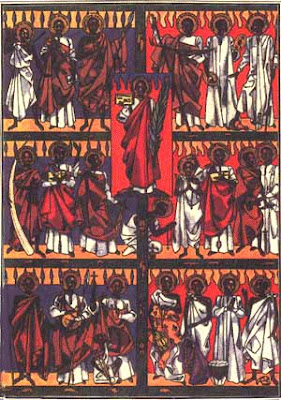
What do you do when you are a eager shining new Christian, you are an obedient member of the court of an absolute monarch, and your absolute monarch is an absolute mess?
Sometimes you have to die.
Mwanga II came to the throne following the unexpected death of his father, Mutesa I. He had an older brother, but that brother was determined unfit to be king. Mutesa was a wise and tolerant ruler. He had welcomed the newly-arrived Muslim and Catholic and Anglican missionaries and had declared religious liberty in Buganda, but had himself remained a traditionalist --- he refused to be circumcised, a requirement to become a Muslim, and he would not abandon his wives, required by both varieties of Christian.
Mwanga II was not nearly so tolerant, however. Not that he had any real beliefs at all, except in the superiority of his royal self. He'd study Islam with the Arabs, or Anglican Christianity with the British, or Catholic Christianity with the French, or consult the shamen, whatever looked to be most advantageous economically and politically to his royal self. And, he considered it his right to be pampered in every imaginable way by the pages of his court --- including their service as his boy-toys.
When pages became Christians, they became extremely resistant to immediate blind obedience, and would hide, run away, or outright refuse to relieve the king's sexual tensions. Higher-ranking court Christians would actually tell the king that he was wrong!
There were sporadic executions --- such as three Anglican pages killed for going to catechism class after Anglican lessons had been forbidden. But the persecution began in earnest when James Hannington, first Anglican bishop of Uganda, was approaching the kingdom, from a direction that the local traditionalist shamen considered inauspicious, and Mwanga sent soldiers to massacre Bishop Hannington and his entire party. Mwanga's majordomo, Yosefu Mukasa Balikuddembe, a Catholic, told him that the killing of Bishop Hannington was evil and wrong, and Mwanga had him executed.
So, one afternoon in mid-May, 1886, Denis Ssebuggwawo sneaked out of the royal compound to Catholic catechism class, and took one of the traditionalist pages withn him, who had shown an interest in Christianity. Unfortunately, this page was Mwanga's current favorite boy-toy, and Mwanga wanted him, now!, and was furious to find out that he'd gone to catechism class --- and was likely to tell the king to buzz off, like all those miserable Christians did sooner or later.
So the king gathered all his pages. The head pages, who were both Christians, gathered their believers around them, and gave them strength. Karoli Lwanga, a Catholic and in charge of pages of the inner court, baptised those who had not yet been baptised. Moses Mukasa, an Anglican and in charge of the outer court, had not received permission to baptise, so the newest Anglican converts went to their trial still catechumens.
In the assembly hall, after a long harrangue about the duties of pages to obey their rightful king, Mwanga called out of the assembly "all of you who pray." And all of the Christians, Anglicans and Catholics alike, stepped out, as did a few of the Muslim pages. Another member of the court weeded out the Muslims, and the Christians were condemned to death, marched, with a few casualties along the way, to the traditional royal site of Namugongo, and burned alive on June 3, 1886. The persecutions continued at a lower level for a few years more, until the death of Mwanga and the enthronement of his successor, who was an Anglican Christian.
The entire list of those martyrs whose names are documented can be found at this link.
The Catholic martyrs were canonized in the early 1960's, and to the best of my knowledge this was the first time the Catholic Church had dealt with a mixed group of martyr-companions. Though it will not be the last --- just two examples: Sophie Scholl and companions, known as the "White Rose" martyrs, are a mixed group, Catholic, Orthodox, and Lutheran; and the martyrs of the Guatemalan persecutions, though mostly Catholics, include also Lutherans and Mennonites.
Yosefu, Karoli, and all your companions, and all holy martyrs, pray for us.
.

What do you do when you are a eager shining new Christian, you are an obedient member of the court of an absolute monarch, and your absolute monarch is an absolute mess?
Sometimes you have to die.
Mwanga II came to the throne following the unexpected death of his father, Mutesa I. He had an older brother, but that brother was determined unfit to be king. Mutesa was a wise and tolerant ruler. He had welcomed the newly-arrived Muslim and Catholic and Anglican missionaries and had declared religious liberty in Buganda, but had himself remained a traditionalist --- he refused to be circumcised, a requirement to become a Muslim, and he would not abandon his wives, required by both varieties of Christian.
Mwanga II was not nearly so tolerant, however. Not that he had any real beliefs at all, except in the superiority of his royal self. He'd study Islam with the Arabs, or Anglican Christianity with the British, or Catholic Christianity with the French, or consult the shamen, whatever looked to be most advantageous economically and politically to his royal self. And, he considered it his right to be pampered in every imaginable way by the pages of his court --- including their service as his boy-toys.
When pages became Christians, they became extremely resistant to immediate blind obedience, and would hide, run away, or outright refuse to relieve the king's sexual tensions. Higher-ranking court Christians would actually tell the king that he was wrong!
There were sporadic executions --- such as three Anglican pages killed for going to catechism class after Anglican lessons had been forbidden. But the persecution began in earnest when James Hannington, first Anglican bishop of Uganda, was approaching the kingdom, from a direction that the local traditionalist shamen considered inauspicious, and Mwanga sent soldiers to massacre Bishop Hannington and his entire party. Mwanga's majordomo, Yosefu Mukasa Balikuddembe, a Catholic, told him that the killing of Bishop Hannington was evil and wrong, and Mwanga had him executed.
So, one afternoon in mid-May, 1886, Denis Ssebuggwawo sneaked out of the royal compound to Catholic catechism class, and took one of the traditionalist pages withn him, who had shown an interest in Christianity. Unfortunately, this page was Mwanga's current favorite boy-toy, and Mwanga wanted him, now!, and was furious to find out that he'd gone to catechism class --- and was likely to tell the king to buzz off, like all those miserable Christians did sooner or later.
So the king gathered all his pages. The head pages, who were both Christians, gathered their believers around them, and gave them strength. Karoli Lwanga, a Catholic and in charge of pages of the inner court, baptised those who had not yet been baptised. Moses Mukasa, an Anglican and in charge of the outer court, had not received permission to baptise, so the newest Anglican converts went to their trial still catechumens.
In the assembly hall, after a long harrangue about the duties of pages to obey their rightful king, Mwanga called out of the assembly "all of you who pray." And all of the Christians, Anglicans and Catholics alike, stepped out, as did a few of the Muslim pages. Another member of the court weeded out the Muslims, and the Christians were condemned to death, marched, with a few casualties along the way, to the traditional royal site of Namugongo, and burned alive on June 3, 1886. The persecutions continued at a lower level for a few years more, until the death of Mwanga and the enthronement of his successor, who was an Anglican Christian.
The entire list of those martyrs whose names are documented can be found at this link.
The Catholic martyrs were canonized in the early 1960's, and to the best of my knowledge this was the first time the Catholic Church had dealt with a mixed group of martyr-companions. Though it will not be the last --- just two examples: Sophie Scholl and companions, known as the "White Rose" martyrs, are a mixed group, Catholic, Orthodox, and Lutheran; and the martyrs of the Guatemalan persecutions, though mostly Catholics, include also Lutherans and Mennonites.
Yosefu, Karoli, and all your companions, and all holy martyrs, pray for us.
.
It's Official!!!!
as reported at Whispers in the Loggia, at last, the heroic virtues and the fact of martyrdom of my own favorite martyr, Franz Jagerstatter, has been affirmed and his beatification has been approved.

Not that I'll ever get to Europe, but ever since I was in grade school I said that if I ever got the chance to cross the ocean, I was going to go to St. Radegund to pray at holy Franz's grave............
.
Not that I'll ever get to Europe, but ever since I was in grade school I said that if I ever got the chance to cross the ocean, I was going to go to St. Radegund to pray at holy Franz's grave............
.
Friday, June 01, 2007
St. Justin and the Eucharist's Six Movements
Today is the memorial of St. Justin, a philosopher of the second century and martyr. A noted philosopher even before his conversion to Christianity, he continued to teach in the schools after his conversion, and also was famous for his public defense of the Christian faith.
St. Justin, in chapters 65-67 of his First Apology, which he wrote to the emperor to defend the Christians from accusations of atheism (wouldn't worship the state gods), promiscuity (treated women as equals and married across class lines), and cannabalism (ate Christ's Body), writes about the six movements through which the Christian people have celebrated the holy Eucharistic Liturgy from the beginning to this very day --- the earliest explanation we have of the movements of the Eucharist.
From St. Justin:
But we, after we have thus washed him who has been convinced and has assented to our teaching, bring him to the place where those who are called brethren are assembled, in order that we may offer hearty prayers in common for ourselves and for the baptized [illuminated] person, and for all others in every place, that we may be counted worthy, now that we have learned the truth, by our works also to be found good citizens and keepers of the commandments, so that we may be saved with an everlasting salvation. Having ended the prayers, we salute one another with a kiss. There is then brought to the president of the brethren bread and a cup of wine mixed with water; and he taking them, gives praise and glory to the Father of the universe, through the name of the Son and of the Holy Ghost, and offers thanks at considerable length for our being counted worthy to receive these things at His hands. And when he has concluded the prayers and thanksgivings, all the people present express their assent by saying Amen. This word Amen answers in the Hebrew language to "so be it". And when the president has given thanks, and all the people have expressed their assent, those who are called by us deacons give to each of those present to partake of the bread and wine mixed with water over which the thanksgiving was pronounced, and to those who are absent they carry away a portion.
And this food is called among us the Eucharist, of which no one is allowed to partake but the man who believes that the things which we teach are true, and who has been washed with the washing that is for the remission of sins, and unto regeneration, and who is so living as Christ has enjoined. For not as common bread and common drink do we receive these; but in like manner as Jesus Christ our Saviour, having been made flesh by the Word of God, had both flesh and blood for our salvation, so likewise have we been taught that the food which is blessed by the prayer of His word, and from which our blood and flesh by transmutation are nourished, is the flesh and blood of that Jesus who was made flesh. For the apostles, in the memoirs composed by them, which are called Gospels, have thus delivered unto us what was enjoined upon them; that Jesus took bread, and when He had given thanks, said, "This do ye in remembrance of Me, this is My body;" and that, after the same manner, having taken the cup and given thanks, He said, "This is My blood;" and gave it to them alone. Which the wicked devils have imitated in the mysteries of Mithras, commanding the same thing to be done. For, that bread and a cup of water are placed with certain incantations in the mystic rites of one who is being initiated, you either know or can learn.
And we afterwards continually remind each other of these things. And the wealthy among us help the needy; and we always keep together; and for all things wherewith we are supplied, we bless the Maker of all through His Son Jesus Christ, and through the Holy Ghost. And on the day called Sunday, all who live in cities or in the country gather together to one place, and the memoirs of the apostles or the writings of the prophets are read, as long as time permits; then, when the reader has ceased, the president verbally instructs, and exhorts to the imitation of these good things. Then we all rise together and pray, and, as we before said, when our prayer is ended, bread and wine and water are brought, and the president in like manner offers prayers and thanksgivings, according to his ability, and the people assent, saying Amen; and there is a distribution to each, and a participation of that over which thanks have been given, and to those who are absent a portion is sent by the deacons. And they who are well to do, and willing, give what each thinks fit; and what is collected is deposited with the president, who succours the orphans and widows and those who, through sickness or any other cause, are in want, and those who are in bonds and the strangers sojourning among us, and in a word takes care of all who are in need. But Sunday is the day on which we all hold our common assembly, because it is the first day on which God, having wrought a change in the darkness and matter, made the world; and Jesus Christ our Saviour on the same day rose from the dead. For He was crucified on the day before that of Saturn (Saturday); and on the day after that of Saturn, which is the day of the Sun, having appeared to His apostles and disciples, He taught them these things, which we have submitted to you also for your consideration.
.
St. Justin, in chapters 65-67 of his First Apology, which he wrote to the emperor to defend the Christians from accusations of atheism (wouldn't worship the state gods), promiscuity (treated women as equals and married across class lines), and cannabalism (ate Christ's Body), writes about the six movements through which the Christian people have celebrated the holy Eucharistic Liturgy from the beginning to this very day --- the earliest explanation we have of the movements of the Eucharist.
From St. Justin:
But we, after we have thus washed him who has been convinced and has assented to our teaching, bring him to the place where those who are called brethren are assembled, in order that we may offer hearty prayers in common for ourselves and for the baptized [illuminated] person, and for all others in every place, that we may be counted worthy, now that we have learned the truth, by our works also to be found good citizens and keepers of the commandments, so that we may be saved with an everlasting salvation. Having ended the prayers, we salute one another with a kiss. There is then brought to the president of the brethren bread and a cup of wine mixed with water; and he taking them, gives praise and glory to the Father of the universe, through the name of the Son and of the Holy Ghost, and offers thanks at considerable length for our being counted worthy to receive these things at His hands. And when he has concluded the prayers and thanksgivings, all the people present express their assent by saying Amen. This word Amen answers in the Hebrew language to "so be it". And when the president has given thanks, and all the people have expressed their assent, those who are called by us deacons give to each of those present to partake of the bread and wine mixed with water over which the thanksgiving was pronounced, and to those who are absent they carry away a portion.
And this food is called among us the Eucharist, of which no one is allowed to partake but the man who believes that the things which we teach are true, and who has been washed with the washing that is for the remission of sins, and unto regeneration, and who is so living as Christ has enjoined. For not as common bread and common drink do we receive these; but in like manner as Jesus Christ our Saviour, having been made flesh by the Word of God, had both flesh and blood for our salvation, so likewise have we been taught that the food which is blessed by the prayer of His word, and from which our blood and flesh by transmutation are nourished, is the flesh and blood of that Jesus who was made flesh. For the apostles, in the memoirs composed by them, which are called Gospels, have thus delivered unto us what was enjoined upon them; that Jesus took bread, and when He had given thanks, said, "This do ye in remembrance of Me, this is My body;" and that, after the same manner, having taken the cup and given thanks, He said, "This is My blood;" and gave it to them alone. Which the wicked devils have imitated in the mysteries of Mithras, commanding the same thing to be done. For, that bread and a cup of water are placed with certain incantations in the mystic rites of one who is being initiated, you either know or can learn.
And we afterwards continually remind each other of these things. And the wealthy among us help the needy; and we always keep together; and for all things wherewith we are supplied, we bless the Maker of all through His Son Jesus Christ, and through the Holy Ghost. And on the day called Sunday, all who live in cities or in the country gather together to one place, and the memoirs of the apostles or the writings of the prophets are read, as long as time permits; then, when the reader has ceased, the president verbally instructs, and exhorts to the imitation of these good things. Then we all rise together and pray, and, as we before said, when our prayer is ended, bread and wine and water are brought, and the president in like manner offers prayers and thanksgivings, according to his ability, and the people assent, saying Amen; and there is a distribution to each, and a participation of that over which thanks have been given, and to those who are absent a portion is sent by the deacons. And they who are well to do, and willing, give what each thinks fit; and what is collected is deposited with the president, who succours the orphans and widows and those who, through sickness or any other cause, are in want, and those who are in bonds and the strangers sojourning among us, and in a word takes care of all who are in need. But Sunday is the day on which we all hold our common assembly, because it is the first day on which God, having wrought a change in the darkness and matter, made the world; and Jesus Christ our Saviour on the same day rose from the dead. For He was crucified on the day before that of Saturn (Saturday); and on the day after that of Saturn, which is the day of the Sun, having appeared to His apostles and disciples, He taught them these things, which we have submitted to you also for your consideration.
.
Wednesday, May 30, 2007
It's hard to beleive it's been five years.....
Today is May 30th. Five years ago this day, the virtual Anchor Hold was born, out of the internecine warfare that mars the face of our holy Church.
Only about ten days before, two of my dearest listserv acquaintances, Mark Shea from the REBORN listserv, and the late Gerard Serafin of FreeCatholic and a few other places (Gerard pray for us!) had written to the lists about their shiny new blogs, and I went over to give them an ogle. On May 23rd, one of my graduate-school classmates delivered a nasty retirement present to my retiring archbishop, and the early long Dormition Fast of 2002 began, and the Catholic portions of the internet seemed to explode, often with statements that appeared to have little or no correspondence with reality. There was so much that needed said, by someone who actually belonged to this local church, so, less than two weeks after I read my first blog, I was writing my own.
I didn't know how to bold or italic or make a link that actually worked, so the first few days were painfully and embarrassingly plain. My first-day posts were an introduction, a reply to Sean of Nota Bene about what had happened here, and a prayer request for our archbishop.
There are ten lessons, truths of faith and life, that were learned, or painfully and powerfully reinforced, in the first few turbulent months of this site, which will remain true no matter what the current troubles are or who might be the current pariah. Or even if the current pariah should come to be me. The site's anniversary is an excellent time to review them:
1) The details of our long-ago-confessed and long-ago-absolved sins and stupidities are the business only of God. They are most definitely not the business of those who would turn them into cudgels.
2) The details of the sins of other people are none of my business; I've enough troubles with my own.
3) Sins and stupidities do not negate goodness, wisdom, love, or generosity.
4) The Accuser of the Brethren can have no foothold among us if we refuse to play his foul game. We must not accuse others, only ourselves. We cannot defend ourselves, even justly, by accusing anybody else of anything; not if we seek to live truly submitted lives.
5) The Church has wisely declared that the Lord can and does use imperfect instruments to build his Kingdom, and that the sacraments are not dependent on the perfection of their ministers. If we insist on having only perfect bishops who have only perfect priests, we will have neither bishops nor priests; for all of us have sinned, every single one of us has done spectacularly stupid things, and even the strongest and most faithful of us come equipped with two clay feet.
6) Where the bishop is, there is the Catholic Church, which the Lord has promised to protect and sustain, and there is no other place where one can be certain of that.
7) When chaos is breaking out all over and the world is spinning and shaking, one reaches deep down inside, down to the foundations of the soul, and finds one of those things that are known to be true and will not change, and one clings tightly to that until the chaos subsides. Two of those unchanging true things are "God made me to know Him, and to love Him, and to serve Him, and to be happy with Him forever and ever in Heaven" and "God is all-good and deserving of all my love."
8) I have myself sinned and have done some incredibly dumb things; I have no right to ridicule anybody, ever.
9) The judgment I judge is the judgment I will be judged by; the forgiveness I offer will be the forgiveness I receive. So how dare I even think of stringent judgment or withholding my forgiveness?
and 10) from the public chapter of faults, the last formal teaching, of my gentle and devoted retired archbishop, who was the designated pariah when this site was brought into being five years ago: I have learned how frail my own human nature is, how in need of God's loving embrace I am. Empty-handed for me now means a willingness to accept my humanity totally, just as Christ accepted that same human nature out of love. But for me it also means to be fully receptive to whatever God wants to place in those hands, to be ready with empty hands to receive new life.
But I am also aware much self-pity and pride remain. I must leave that pride behind. Each day I will try to leave room for God to enter into my life more and more. Ultimately I understand that the humanity God so loved and sought to redeem, including my own humanity, will be transformed by his loving embrace and grace.
.
Only about ten days before, two of my dearest listserv acquaintances, Mark Shea from the REBORN listserv, and the late Gerard Serafin of FreeCatholic and a few other places (Gerard pray for us!) had written to the lists about their shiny new blogs, and I went over to give them an ogle. On May 23rd, one of my graduate-school classmates delivered a nasty retirement present to my retiring archbishop, and the early long Dormition Fast of 2002 began, and the Catholic portions of the internet seemed to explode, often with statements that appeared to have little or no correspondence with reality. There was so much that needed said, by someone who actually belonged to this local church, so, less than two weeks after I read my first blog, I was writing my own.
I didn't know how to bold or italic or make a link that actually worked, so the first few days were painfully and embarrassingly plain. My first-day posts were an introduction, a reply to Sean of Nota Bene about what had happened here, and a prayer request for our archbishop.
There are ten lessons, truths of faith and life, that were learned, or painfully and powerfully reinforced, in the first few turbulent months of this site, which will remain true no matter what the current troubles are or who might be the current pariah. Or even if the current pariah should come to be me. The site's anniversary is an excellent time to review them:
1) The details of our long-ago-confessed and long-ago-absolved sins and stupidities are the business only of God. They are most definitely not the business of those who would turn them into cudgels.
2) The details of the sins of other people are none of my business; I've enough troubles with my own.
3) Sins and stupidities do not negate goodness, wisdom, love, or generosity.
4) The Accuser of the Brethren can have no foothold among us if we refuse to play his foul game. We must not accuse others, only ourselves. We cannot defend ourselves, even justly, by accusing anybody else of anything; not if we seek to live truly submitted lives.
5) The Church has wisely declared that the Lord can and does use imperfect instruments to build his Kingdom, and that the sacraments are not dependent on the perfection of their ministers. If we insist on having only perfect bishops who have only perfect priests, we will have neither bishops nor priests; for all of us have sinned, every single one of us has done spectacularly stupid things, and even the strongest and most faithful of us come equipped with two clay feet.
6) Where the bishop is, there is the Catholic Church, which the Lord has promised to protect and sustain, and there is no other place where one can be certain of that.
7) When chaos is breaking out all over and the world is spinning and shaking, one reaches deep down inside, down to the foundations of the soul, and finds one of those things that are known to be true and will not change, and one clings tightly to that until the chaos subsides. Two of those unchanging true things are "God made me to know Him, and to love Him, and to serve Him, and to be happy with Him forever and ever in Heaven" and "God is all-good and deserving of all my love."
8) I have myself sinned and have done some incredibly dumb things; I have no right to ridicule anybody, ever.
9) The judgment I judge is the judgment I will be judged by; the forgiveness I offer will be the forgiveness I receive. So how dare I even think of stringent judgment or withholding my forgiveness?
and 10) from the public chapter of faults, the last formal teaching, of my gentle and devoted retired archbishop, who was the designated pariah when this site was brought into being five years ago: I have learned how frail my own human nature is, how in need of God's loving embrace I am. Empty-handed for me now means a willingness to accept my humanity totally, just as Christ accepted that same human nature out of love. But for me it also means to be fully receptive to whatever God wants to place in those hands, to be ready with empty hands to receive new life.
But I am also aware much self-pity and pride remain. I must leave that pride behind. Each day I will try to leave room for God to enter into my life more and more. Ultimately I understand that the humanity God so loved and sought to redeem, including my own humanity, will be transformed by his loving embrace and grace.
.
Saturday, May 19, 2007
Two new priests!
Last night was Milwaukee's ordination day, and we now have two fine new priests, Fr. Sean and Fr. Carmelo. A youngster and one who already has wisdom and age. The men entering major seminary in 2002 had a lot of extra trials, above and beyond the normal stress and hard work of study and discernment, and they persevered.
Actually, we'll have three new priests this year --- a third is studying in Rome and will be ordained in July (God willing...) out in the Unknown Lands beyond 124th Street where dragons dwell and the transit doesn't go.
Pray for all priests, and especially the new ones wherever you are.
.
[edit] links to the new Fathers' testimonies, from the Catholic Herald
Fr. Sean: Boot camp was step toward priesthood
Fr. Carmelo: Priesthood came from ‘dreaming big’
.
Actually, we'll have three new priests this year --- a third is studying in Rome and will be ordained in July (God willing...) out in the Unknown Lands beyond 124th Street where dragons dwell and the transit doesn't go.
Pray for all priests, and especially the new ones wherever you are.
.
[edit] links to the new Fathers' testimonies, from the Catholic Herald
Fr. Sean: Boot camp was step toward priesthood
Fr. Carmelo: Priesthood came from ‘dreaming big’
.
Sunday, May 06, 2007
Catholic praise choruses, anyone?
According to Brian Michael Page, there's a favorite hymns meme making the rounds. I'm going to dodge that one because 1) there are just too many good hymns and 2) when I mention some of them, I end up being told "Hey, that's not a hymn! that's a _______!"
So, as I've been cruising around the town on my daily constitutionals, I seem to have reverted to my prior habit, back in my able-bodied days, of singing "psalms, hymns, and spiritual songs" --- also known as Catholic praise choruses ---- at the bus stop. Or, nowadays, while tooling down the sidewalk on Maxima. Here's the ones I've caught myself singing in the streets:
Gloria, laus, et honor (the 12th century polyphonic one that sounds like sycopated dance music)
Laudate, laudate Dominum (by Walker?)
Laudamus Te (Jeffrey Honore)
Praise God in His holy Dwelling (Psalm 150, Vermulst)
I Know that my Redeemer lives (and on that last day I will rise again.... by Robert Fabing)
To Jesus Christ, Our Sovereign King
O filii et filiae.
Anyone have their own streetcorner praise favorites?
.
So, as I've been cruising around the town on my daily constitutionals, I seem to have reverted to my prior habit, back in my able-bodied days, of singing "psalms, hymns, and spiritual songs" --- also known as Catholic praise choruses ---- at the bus stop. Or, nowadays, while tooling down the sidewalk on Maxima. Here's the ones I've caught myself singing in the streets:
Gloria, laus, et honor (the 12th century polyphonic one that sounds like sycopated dance music)
Laudate, laudate Dominum (by Walker?)
Laudamus Te (Jeffrey Honore)
Praise God in His holy Dwelling (Psalm 150, Vermulst)
I Know that my Redeemer lives (and on that last day I will rise again.... by Robert Fabing)
To Jesus Christ, Our Sovereign King
O filii et filiae.
Anyone have their own streetcorner praise favorites?
.
Friday, May 04, 2007
From the listserv world
When someone tells you to ask yourself,
"What would Jesus do?",
remember that at least one valid answer is,
"Freak out and knock over tables."
and:
Sure I'm a practicing Catholic. Practice, practice, practice, until I get it right.
.
"What would Jesus do?",
remember that at least one valid answer is,
"Freak out and knock over tables."
and:
Sure I'm a practicing Catholic. Practice, practice, practice, until I get it right.
.
Subscribe to:
Posts (Atom)